
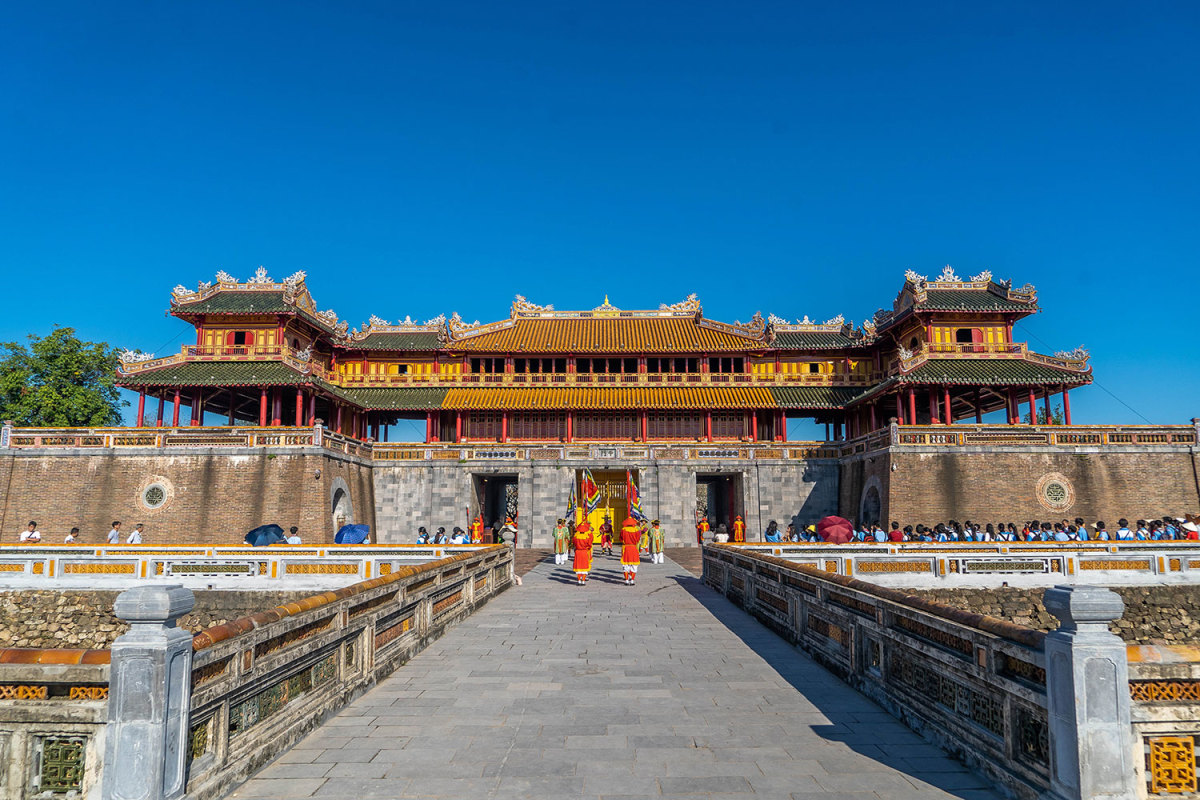
Hue City has been depicted with many great words of praise. The Ancient Capital still retains a rare tranquility amidst the fast-blooming tourism of the 21st century. Hue is notable for its well-preserved urban area, reflecting the heritage of its imperial past and enduring cultural customs.
Additionally, its temples, palaces, and mausoleums are beautifully designed, with their arrangement inspired by rivers and mountains. Despite its past splendor, Hue modestly exudes a unique charm that remains true to the ancient quintessence of Vietnam, with a subtle rusticity that harmonizes with nature. Visitors come to Hue to recover from their post-holiday fatigue and truly immerse in its unique beauty, which has become iconic of the Central Coastline
Overview
One destination Five Heritage Sites – Hue City is located in the central region of the S-shaped country, Thua Thien Hue is bordered by the majestic Truong Son Mountain Range to the west, and to the east, the captivating coastline and territorial waters of Vietnam’s East Sea. Hue City is Thua Thien Hue’s administration, culture, and economy center. In 1306, following the marriage proposal from King Che Man of the Kingdom of Champa to Princess Huyen Tran of the Tran Dynasty, Thua Thien Hue became part of Dai Viet the same year.
Hue, a city with deep historical significance, has played a pivotal role in the history of Vietnam. With a history of Nguyen lords and Nguyen Dynasty, Hue has evolved into a destination that offers an extraordinary glimpse into the past.
Today, it boasts five UNESCO World Cultural Heritage sites, each a testament to the city’s vibrant history and cultural heritage.
Five UNESCO World Cultural Heritage of Hue City
1. The Complex of Hue Monuments
World Heritage Site (1993) Laying by the dreamy Perfume River, the Complex of Hue Monuments comprises numerous historical-cultural relics built during the Nguyen dynasty (5.2km Imperial Citadel, palaces, mausoleums, temples, and pagodas). This site is a prime example of the harmony between urban beauty and natural landscapes. Some places mentioned here include more than 60 places/ architecture, We can divide it into 3 projects with different functions
Royal Palaces
- Hue Imperial Citadel: This is a massive fortress that was the capital of the Nguyen Dynasty. It is a UNESCO World Heritage Site.
- An Dinh Palace: the private palace of Khai Dinh King
- Truong Sanh Palace: This palace was once a residence for the mothers and wives of emperors..
- Van Lau Pavilion: A beautiful pavilion located on the banks of the Perfume River, where the King gives any document to local people…
Royal tombs
- Gia Long Tomb: The tomb of Gia Long, the first emperor of the Nguyen Dynasty.
- Minh Mang Tomb: The tomb of Emperor Minh Mang, is known for its architectural and natural beauty.
- Thieu Tri Tomb: The tomb of the third emperor of the Nguyen Dynasty, Emperor Thieu Tri.
- Tu Duc Tomb: The tomb of Emperor Tu Duc, the fourth emperor of the Nguyen Dynasty.
- Duc Duc Tomb: The tomb of Emperor Duc Duc, is known for its simplicity and modesty.
- Hiep Hoa Tomb: This tomb belongs to Emperor Hiep Hoa, known for its tranquil and picturesque surroundings.
- Dong Khanh Tomb: This tomb is a mix of Western and Eastern architectural styles, belonging to Emperor Dong Khanh.
- Khai Dinh Tomb: The tomb of Emperor Khai Dinh, is known for its blend of Western and Eastern design elements…
Pagoda/ Temples
- Hon Chen Temple: A temple dedicated to the Goddess Po Nagar, showcasing the Champa culture.
- Tiger Arena: A historic fighting arena where duels between elephants and tigers were held.
- Nam Giao: An outdoor altar, where the Nguyen emperors conducted religious ceremonies.
- Hue Literature Temple: A temple dedicated to Confucius, highlighting the importance of education and literature in Vietnamese culture…
2. Royal Court Music World
Intangible Cultural Heritage of Humanity (2003) Royal court music (Nhã Nhạc Cung Đình) was institutionalized in the 15th century and skillfully refined in the Nguyen dynasty. Distinct from folk music, this is the official form of music in court ceremonies and festivals. It was considered a means of communication and expressing respect to deities and kings. The Nguyen reign held nearly 100 performances annually.
Royal Court music performance and court dance at Duyet Thi Duong Theater – a small theater in Hue Imperial Citadel
To watch this show, you don’t pay more fees, but if you want to see it, you have to pay entrance tickets to Hue Imperial Citadel (200.000 vnd/ adult)
- Tiểu Nhạc (Traditional performance): 8 am daily, in front of Thai Hoa Palace | Free
- Đại Nhạc (Concert Performance): 3:30 pm – 3:45 pm daily at The Mieu Temple | Free
3. Literature on Hue Royal Architecture
World Documentary Heritage in the Asia-Pacific Region (2016)
Those charming verses from kings, princes, and officials, etched onto wooden bas-reliefs, architectural structures, or delicate porcelain, created a unique collection of calligraphy and art. It’s like a beautiful reflection of a time when Confucian literature was blossoming in Vietnam, thanks to the nurturing reigns of kings like Minh Mang, Thieu Tri, and Tu Duc King
4. Nguyen dynasty’s Chau Ban:
Royal Court’s administrative document system. Chau ban, including laws, decrees, edicts, and instructions for resolving problems in various fields such as politics, military affairs, foreign affairs, economy, society, and culture. These documentaries also recorded details of the administrative reforms of the Nguyen Kings.
5. Moc Ban – World Documentary Heritages
Woodblocks are boards of wood carved with Han Nom (Sino-Vietnamese) characters as a popular method of printing in Vietnam in feudal times. The woodblocks carved provide reliable sources for research, collation, and study of various fields in Vietnam.
Visitors can explore some national documents in Tang Thu Lau (Royal Library at 346 Dinh Tien Hoang Rd., Hue City): https://maps.app.goo.gl/8HAWRc9NoJQdjeC2A
or in Da lat city: Trung tâm Lưu trữ quốc gia IV (trực thuộc Cục Văn thư và lưu trữ nhà nước). Số 2 Yết Kiêu, TP Đà Lạt, Tỉnh Lâm Đồng: https://maps.app.goo.gl/JKKS5945zg1EaYZ47
Travel guide
- To visit Hue City, a local taxi or Hue private car is the most popular to go around. You can spend at least 1 day to visit the Complex of Hue Monuments
- Don’t forget that combo tickets are the best deal to visit the complex of Hue monuments including: Hue Imperial Citadel, Khai Dinh tomb, Tu Duc Tomb, Minh Mang tomb from 520.000 vnd
- Don’t forget the dress code for visiting the pagoda, temple, and palaces in Hue.